Kilbarrack Road to Oscar Traynor Road Active Travel Scheme
Dublin City Council plans to provide 5km of improved walking and cycling facilities along Kilbarrack Road, Tonlegee Road and Oscar Traynor Road. This scheme is currently in the Detailed Design and Procurement phase.
This scheme will deliver a 5km cycle route along Kilbarrack Road, Tonglegee Road and Oscar Traynor Road between the Howth Road / Dublin Road junction and Oscar Traynor Road / Barryscourt Road junction.
This scheme is part of Dublin City Council's Active Travel Network. To see where this scheme fits into the citywide network, view our interactive map.
The main features of the scheme include:
- Upgrading of existing 1.4km of cycle lanes on Kilbarrack Road to dedicated, protected cycle tracks.
- Construction of new protected cycle tracks along Kilbarrack Road, Tonlegee Road and Oscar Traynor Road.
- One-way cycle tracks on either side of the road in compliance with the new National Transport Authority (NTA) Cycle Design Manual 2023.
- Signalised junction upgrades with improved cycling and pedestrian crossing facilities.
- Improved pedestrian crossings at side roads junctions, with tightened radii and continuous footpaths.
- Public Realm Improvements at various locations.
- This scheme will be delivered in three phases:
- Ph1 – Oscar Traynor Road
- Ph2 – Tonlegee Road
- Ph3 – Kilbarrack Road




Learn More About This Scheme
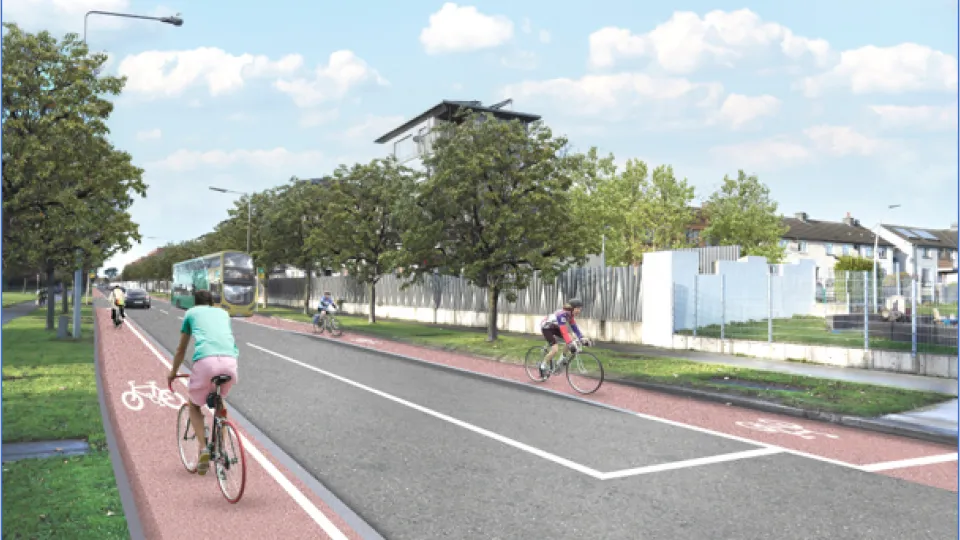
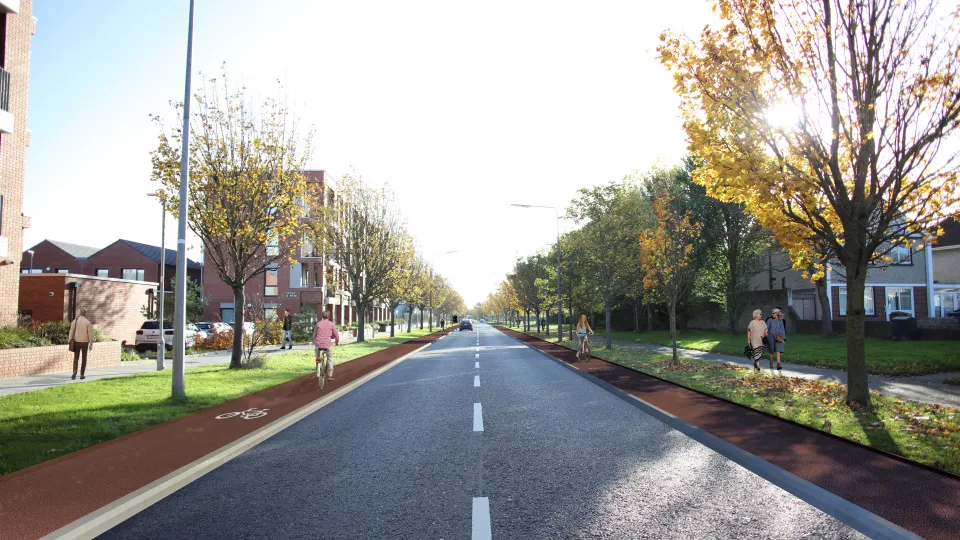
This scheme will improve the look and feel of the area and make it easier and safer to walk, wheel, cycle or use public transport.
It will connect communities along this route, linking with the Clongriffin to City Centre BusConnects and the proposed Santry River Greenway Schemes.
This scheme forms part of Dublin City Council’s overall 314km Active Travel Network, which aims to transform the way people travel in the city to achieve multiple benefits including:
- Reduced pollution and carbon emissions.
- Improved physical and mental health and wellbeing.
- More connected communities.
- More pleasant environments.
- Stimulated local business activity.
This is a busy route with a lot of amenities, and the aim of this scheme is to make it easier, safer and more pleasant for people to walk, wheel, cycle or use public transport.
It is our intention to deliver this scheme under Section 38 of the Road Traffic Act 1994. This means that the scheme does not require approval from An Bord Pleanála.
For more information on Section 38 of the Road Traffic Act 1994, visit Road Traffic Act, 1994, Section 38
Dublin City Council consults with the public about all new schemes. It is important for us to gather the opinions and knowledge of the people who live and work in the local area. This is to ensure that each scheme meets the needs of those who are most affected by it.
Dublin City Council carried out a non-statutory public consultation for the project between Monday, 19th December 2022 and Monday, 30th January 2023. Consultation responses could be submitted by email, post or by filling out the questionnaire on the Dublin City Council Consultation Hub website.
Feedback received as part of this process was incorporated in the scheme design. The full public consultation report can be viewed at the following link
We held a public information event to provide updates on the scheme:
- Tues, 30th June 2026, 4-7pm at the Northside Civic Centre, Bunratty Road, Bonnybrook, Dublin D17 K462
In addition, Dublin City Council conducts a separate process for consulting with Disabled Persons’ Organisations / Disabled Persons’ Representative Organisations (DPOs/DPROs)
This scheme is being funded by the National Transport Authority.
No parking spaces are being removed to facilitate this scheme.
An arborist has been appointed, and they have completed a tree survey to assess the possible impacts. A total of 15 trees are expected to be removed during the construction phase. Removal of trees is taken as a last resort where no other design alternative exists.
Trees to be removed are highlighted in red on the General Arrangement drawings available on the project website. The arborist will also develop a tree protection plan as the design progresses to ensure protective measures are in place during construction.
A landscaping plan will be developed during the detailed design process which will ensure a net gain in planting and regreening upon project completion.