Dublin City Assembly
The city of Dublin has been governed by its own elected representatives since the 12th century. The Dublin City Assembly which flourished during the Middle Ages and survived until 1840, met at the great feasts of Christmas, Easter, Midsummer and Michaelmas, but extra meetings were held when necessary.
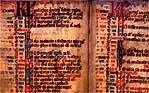
Historical Civic and Administrative Records of Dublin
Assembly and Municipal Franchise
The Mayor presided at meetings of the Assembly, whose members consisted of two sheriffs, 24 aldermen, 48 sheriffs’ peers and 96 representatives of the Dublin trade guilds. The municipal franchise was not democratic in the modern sense, as it was largely confined to guild members and their descendants.
Dublin City Charters (1171–1727)
The City Archives holds a series of 102 charters granted to Dublin by successive English monarchs. The earliest was issued by Henry II in 1171–1172, granting the men of Bristol the right to live in Dublin. Subsequent charters granted rights, privileges and property to the city, forming the basis of municipal law in Ireland.
Texts of selected charters are available in the Calendar of Ancient Records of Dublin, which can be consulted in the Reading Room of Dublin City Library and Archive.
Guild Records (1192–1841)
Guilds were mutual benefit associations active across Western Europe from the 11th century. Dublin’s guild system was licensed under a charter by Prince John in 1192 and played a major role in commercial and political life.
Types of Guilds
- Guild Merchant or Merchant Guild
- Craft Guilds or Trade Guilds
- Religious Guilds
- Military Guilds
Ways to Obtain Guild Membership
- Service: completing an apprenticeship with a guild member
- Birth: inherited by sons of guild members
- Freedom: honorary membership conferred on dignitaries
Freedom Records (1225–1922)
The ancient Freedom of Dublin dates to the Norman Invasion. Dubliners were classified as free or non‑free, and ‘Free Citizens’ enjoyed significant trading rights and the right to vote in parliamentary and municipal elections.
Freedom typically required birth within the city’s boundaries or membership of a guild. While members of “the Irish nation” were formally excluded, many individuals with Irish surnames successfully obtained the freedom.
Roman Catholics were excluded under the Penal Laws (1691–1793). The Freedom was abolished under the Representation of the People Act (1918), replaced by a more democratic franchise.
Freedom lists are an important source for genealogical research.
To view the Freedom Records: search the Ancient Freemen of Dublin database.
Please note: This database (databases.dublincity.ie) was taken offline on 4 March 2024. Materials are available for consultation in the DCLA Reading Room, 139–144 Pearse Street, Dublin 2. To make an appointment, email [email protected].
Liber Albus or White Book of Dublin (13th–17th century)
This vellum volume contains transcripts of documents in abbreviated Latin, French and old English. It covers civic transactions involving lands, buildings, mills and water