Next Week, East Lynne!
Published on 14th November 2025
Next Week, East Lynne!
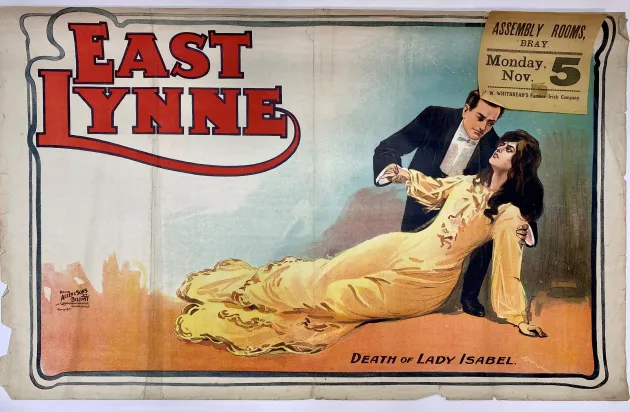
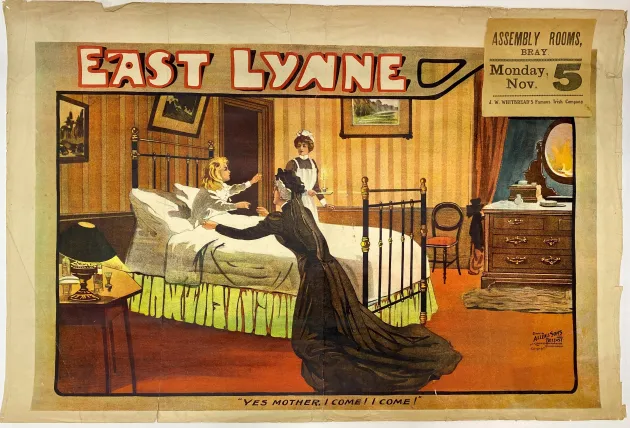
It is thrilling to uncover an object that was seen on our streets over a hundred years ago. The team at Dublin City Library and Archive recently had this pleasure when working on some theatre posters in the collection. Two of the most eye catching of these were for a production of the melodrama East Lynne in the early 1900s (IMAGES 1 and 2).
East Lynne by Ellen Wood was first published in serial form in the New Monthly Magazine and appeared as a stand-alone novel in September 1861. Adapted for the stage as early as the mid-1860s, it found success on both sides of the Atlantic, becoming a staple of the theatre world and its audiences, including those in Ireland. Such was its popularity that the slogan “Next Week – East Lynne!” became a familiar sight outside of theatres if a current production was doing poorly at the box office. Losses might be made up by promising this ‘sure thing’ to entice audiences back the following week.
The play had all the ingredients for success with audiences of the period: vice and virtue, secrets and lies, domesticity and death. In the same vein as stories like The Woman in White and Lady Audley’s Secret, East Lynne centres on the character of Lady Vane who marries well, is seduced, undergoes a disfiguring accident, poses as governess to her own children, witnesses the death of her son and ultimately meets a sorry end herself. One poster shows her at her son’s deathbed as he calls for his mother whilst the other shows her own demise.
Printed by the firm of David Allen and Sons, the posters capture the dramatic gestures and lighting associated with melodrama on stage. The characters, mimicking the striking gestures that might have been used by the original actors, are shown within realistic and ‘respectable’ domestic interiors. This made the plot even more shocking to audiences who often participated very actively in performances by booing, weeping and heckling at the antics on stage.
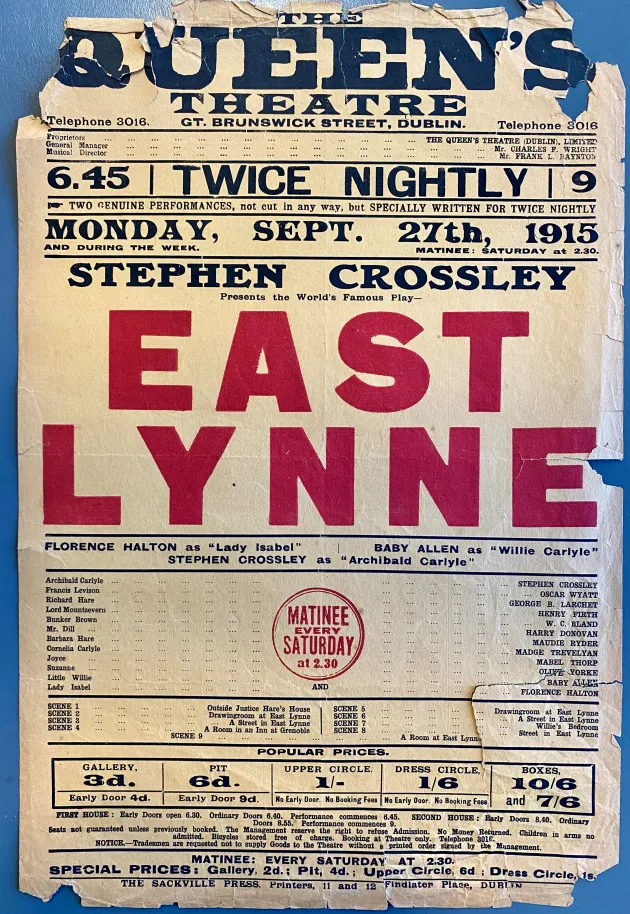
This series of posters was produced using lithography, and in this case, we know that theatre companies could choose from at least two variations illustrating key scenes in the play. The lithographic process was particularly attractive because of its use of images, and the fact that decorative lettering could be incorporated into the image rather than being printed separately using the letterpress process. The contrast between the two printing processes is very clear when you compare the effect of these posters with those of letterpress handbills for the same play performed in the Queen’s Theatre on Brunswick (now Pearse) Street. (IMAGE 3).
The art nouveau style of the lettering used on David Allen’s posters would have lent the production a modern air, and the use of the framing device both gave the impression of a glimpse into the private lives of the characters in this domestic drama and of an audience looking at the play on stage. Pasted on billboards or walls on the streets, the same images might have been seen in London, Belfast or Cork as well as in Dublin and so the specific details of a production were overprinted on the poster itself, or as is the case here, printed separately and attached as needed later.
These posters advertise a production by J.D Whitbread, also manager of the Queens. The play took place in the Assembly Rooms in Bray on Monday November 5th: There was a version staged in the Queen’s in 1900, when Whitbread was manager, when November 5th did indeed fall on a Monday. The Weekly Freeman of the 29th May 1905 also describes a production of “the most successful of all the domestic dramas” performed in the Queen’s that had already been in production for four years, and this version might also have been the one performed in Bray. The article describes the introduction of songs and dances to the play as being “a decided novelty”, and one which had led to crowded houses throughout its four years on tour.
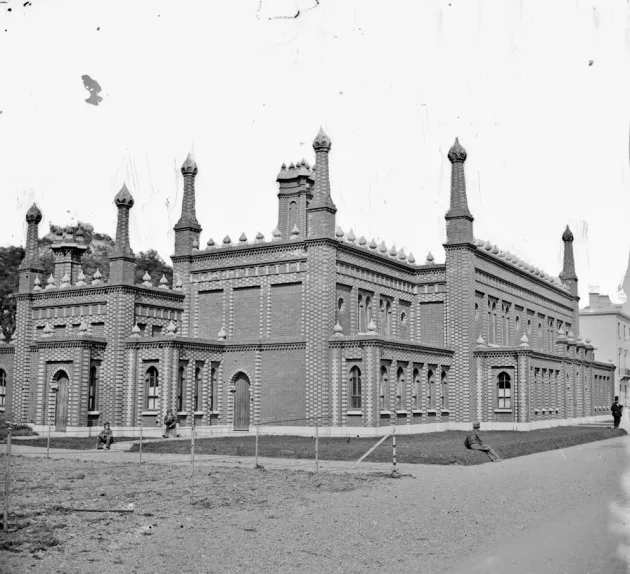
The venue, described on the posters as the Assembly Rooms, had been built originally as a Turkish Baths by Dr. Richard Barter (IMAGE 4). The building, which no longer survives, stood on Quinsborough Road, Bray, and one can imagine the posters adorning walls along this attractive boulevard. Following the closure of the baths, the venue was adapted for a variety of purposes including lectures and meetings, but it’s decorative red brick exterior, minaret-like towers and ogee shaped doorways were perhaps thought to be appropriate for leisure pursuits like theatrical productions and would surely have added to the drama being enacted on stage in East Lynne.