All Together Now! Song Sheets in Dublin City Library and Archive
Published on 10th December 2025
Some of the song sheets have titles that have a broad appeal and refer to features common to lots of places in Ireland. There was space for comedy too and one can imagine these being popular for sing-songs at many gatherings of Irish people living abroad.
Christmas music often holds a special place in our hearts, evoking nostalgia for Christmases past, or as we imagine the season should be. This is especially so for the multitudes who left Ireland over the years, and for the people they left behind. Some of the song sheets in the collections of Dublin City Library and Archive reflect this longing.
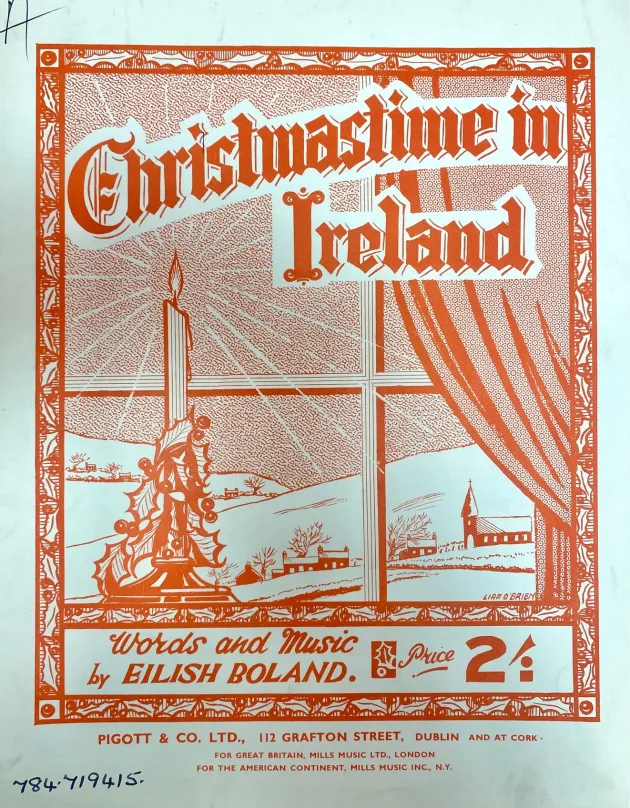
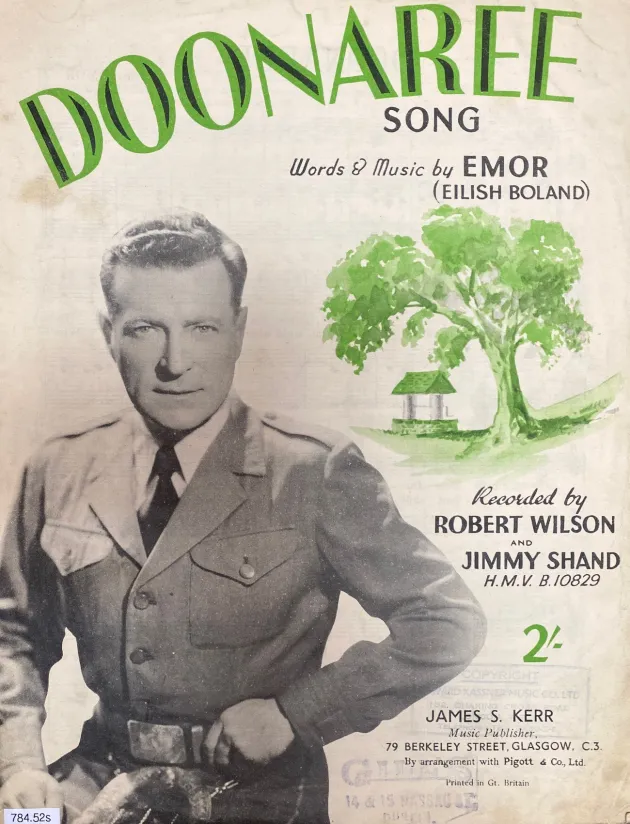
Eilis Boland’s ‘Christmas in Ireland’ focuses on the poignant idea of absent friends at this time of year, asking whether those who have left will be remembered back home in the glow of the Christmas candle, a very Irish tradition. Boland, neé Farelly, was born in Kingscourt, Co. Cavan in 1917 and was known for songs such as Ballyhoe, A Wee Sprig of Green, Our Wedding Day, The Mountains of Cooley and An Irish Boreen. One of her best known songs, ‘Doonaree’, was recorded by Dame Vera Lynn, amongst others. The version in our collection was published in 1954 and sung by Scottish tenor Robert Wilson.
Some of the song sheets in our collections have titles that have a broad appeal and refer to features common to lots of places in Ireland, like that based on the poem ‘The Old Bog Road’ by Teresa Brayton which tells of an emigrant, his feet in Broadway, but his heart at home. Others draw attention to specific places like ‘Connemara Lullaby’ (Liam Daly) and ‘Homes of Donegal’ (Sean MacBride). ‘Dear Oul' Dublin’ (Fay Sargent) assures us that it’s singer, a Dublin bargee, will always return to his own “Magzer Byrne, who waits for me near Inchicore.”

There was space for comedy too, and one can imagine these being popular for sing-songs at many gatherings of Irish people living abroad. ‘Fast Boat to Ireland’, which tells the story of Clancy who travels to London and New York, but ultimately hightails it home, was written by Ray Boyd and Meath man Dick Farrelly. Farrelly is best known for his ‘The Isle of Innisfree’ that features in ‘The Quiet Man’ (1952). ‘Let him Go Let him Tarry’ was one for the girls, whilst Are You There Moriarity? written by Louis A. Tierney, is one that’s easy for everyone to join in on.
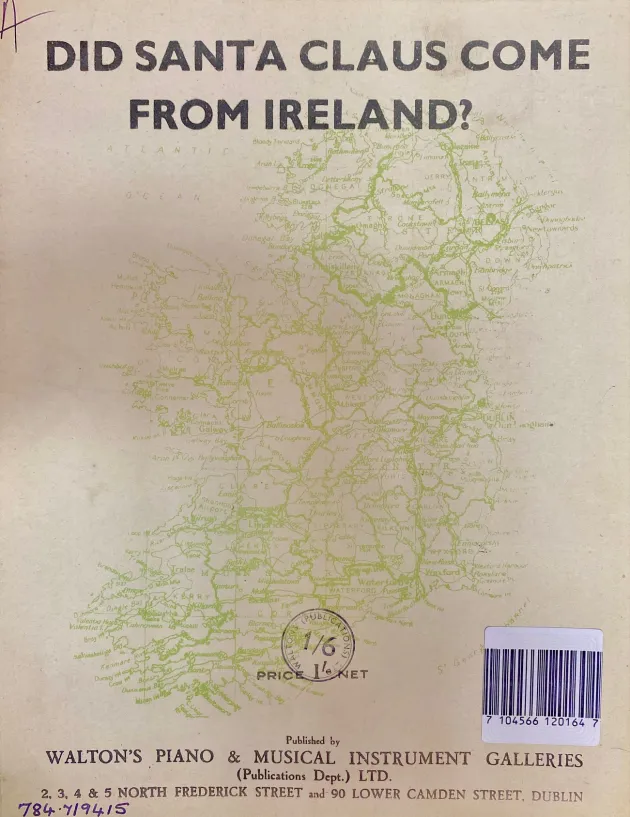
John MacDonagh, brother of Tomás, wrote ‘Did Santa Claus Come from Ireland?’, published by Walton’s in Dublin, and in 1949 by the Leeds Music Corporation of Radio City, New York. MacDonough had been involved in the 1916 rising alongside his brother and afterwards had gone on to be involved in film, theatre and broadcasting creating plays, sketches and songs which were well received on both stage and radio. Correspondence in the collections here extends our understanding of his Christmas song. Lou Levy of the Leeds Corporation wrote to Martin Walton in March 1949, thanking him for sending on two of MacDonough’s compositions. MacDonough’s Christmas offering received an enthusiastic response from Levy, whilst his second song, Home to Mayo - although praised - was not required. A month later, Leeds Music Corporation wrote again to Walton, expressing the intention to secure Bing Crosby, no less, to record the song. A letter from the company to John MacDonough in 1952 confirms the song had been recorded, but not by whom. Although the song does not claim the big man as one of our own, it does admit that he was, at least, good enough to be Irish for, like those for whom the song was intended, “Tis himself had an Irish heart”.