Staff Pick: A John Banville Selection as Part of One Dublin One Book
Published on 10th March 2026
As part of the Dublin One Book 2026 celebrations, our Reader Services team have put the spotlight on four standout titles from John Banville’s thirty-one novels. There are plenty of delights to be found in the Banville backlist. We’ve set aside his best-known works, The Book of Evidence and The Sea, but, if you want to explore further, then the following are highly recommended.

Image: John Banville
Kepler (1981)
John Banville’s Kepler, a fictional biography of the astronomer Johannes Kepler, immerses the reader in the blood, muck, and intellectual controversies of 16th- and 17th-century Central Europe. Johannes Kepler — one of the pivotal figures of the Scientific Revolution — is presented not only as the genius who discovered the elliptical orbits of the planets, but as a man struggling to navigate poverty, faith, politics and personal tragedy.
Banville contrasts Kepler’s soaring mathematical imagination with his turbulent domestic and professional life. Patronage was dependent on the whims of disinterested nobles for whom scientific inquiry was an ornament or a convenient buttress of theology. Kepler’s most secure employment came, ironically, from providing astrological guidance to Emperor Rudolf II — a reminder of how entangled early science was with superstition and courtly expectation.
Religion was a deadly issue in the seventeenth century. As Europe edged toward the carnage of the Thirty Years’ War, Kepler’s Lutheranism cost him security and status, while accusations of witchcraft against his mother further destabilised the family. Banville skilfully weaves these religious and social pressures together, showing how they shaped the tensions within Kepler’s marriage to Barbara, whose own family believed she had married beneath her.
The novel moves fluidly between imperial courts, taverns, castles, and brothels. It juxtaposes the ecstasy of scientific discovery with the grind of family life. Banville’s masterstroke is to give equal weight to both. Readers who mistakenly think of Banville as a writer ‘more of the head than the heart’ are directed to the passage where Kepler’s first child dies of meningitis.
Kepler is a remarkable and sometimes underappreciated novel. It is one of the finest achievements by an Irish writer. It offers both an intimate portrait of a brilliant, conflicted man and a vivid panorama of an age in upheaval.
Find a copy of Kepler in the library
Read Next: Arthur Koestler, The Sleepwalkers: A History of Man’s Changing Vision of the Universe

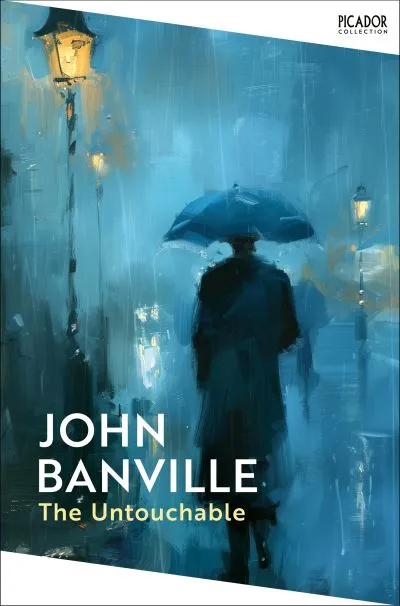
The Untouchable (1997)
The Untouchable is Banville’s great study of betrayal. Its protagonist, Victor Maskell, is a fixture of the higher realms of British society: an esteemed art historian, a Knight of the Realm, and Keeper of the King’s—later the Queen’s—Pictures. This facade cracks in the 1970s when Maskell is exposed as a Russian agent, a revelation that forces him to confront the contradictions of his life.
Maskell is an outsider in almost every sphere he occupies. As both Irish and homosexual, he is estranged from the masters he serves. This is a man watching himself from a distance, detached from the wreckage he causes.
The tone is one of dark comedy, sharpened by Maskell’s chilling lack of remorse. There are no confessions, no moral revelations, no gestures toward redemption. He freely admits to having sent men and women to terrible deaths but thinks little of it. Maskell is an unloving husband, a remote father, and a detached son. Banville presents a man hollowed out long before the world uncovers his treachery.
One of the novel’s strongest sections examines the British establishment’s flirtation with Communism in the 1930s. Banville lays bare the vanity that sometimes underpinned these ideological commitments. High-minded talk of freedom and justice disguised what Maskell calls “all selfishness.” His own politics seem less rooted in conviction than in an aesthetic revulsion toward America, a telling detail in a novel that intertwines public ideology with private identity.
Maskell’s post-war work takes him to Bavaria, where he is tasked with cleaning up one of the Royal Family’s dirty little secrets. Yet even here, loyalty holds no sway. He is a man for whom allegiance—to family, to nation, to lovers, to ideology—means almost nothing. The only constant in his life is art, and particularly the painting The Death of Seneca, which emerges in the novel as a symbol of stoicism, performance, and self-mythologising—qualities Maskell embraces to the end.
The Untouchable is a masterful psychological portrait. Banville delineates a man who is at once monstrous and magnetically compelling. It is a novel about identity, duplicity, and the lies we tell when we are confronted with our darker selves.
Find a copy of The Untouchable in the library
Read Next: John Le Carré, Tinker Tailor Soldier Spy
The Infinities (2009)
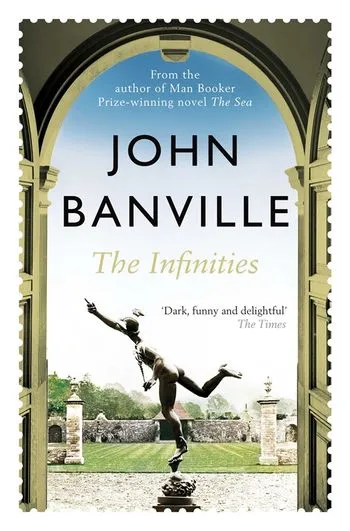
In The Infinities the Greek gods wander once again in the mortal realm, observing —sometimes meddling in— human affairs. The story centres on one day at the estate of Adam Godley, a brilliant mathematician who is lying on his deathbed. His family have gathered in anticipation of the end. Unspoken desires and resentments simmer below the surface.
Enter the gods – Zeus, Hermes, and Pan – who have mischief in mind. They assume human disguises: Zeus appears as the younger Adam Godley in order to seduce his wife, Hermes as a cowman who works the estate, and Pan as the mysterious Benny who promises ‘all the temptations of the world and its steamy pleasures’. The gods cannot experience love – a human invention – and this limitation informs their envy and meddling.
In counterpoint to its mythological theme, Banville’s earthy, celebratory writing is determined to show the immortals just what they are missing – life presented as ‘raw and coarse and vital’. The smallest sensations are described with a luminosity. There is no doubt, for Banville, that the mortals – despite the everyday tragedies of life – have got the better deal.
Ultimately, The Infinities is a novel about grief and acceptance. It contains some of Banville’s most tender writing. Old Adam watches his son and daughter and reflects: ‘When he and the girl were small I used to pray that I would live to see them grown; now I am thankful I shall not see them old’.
In The Infinities, we are shown mortal existence from the transcendental perspective of the gods and human life is presented as precious and wonderful because our time in the world is so transient.
Find a copy of The Infinities in the library
Read Next: John Banville, The Singularities.
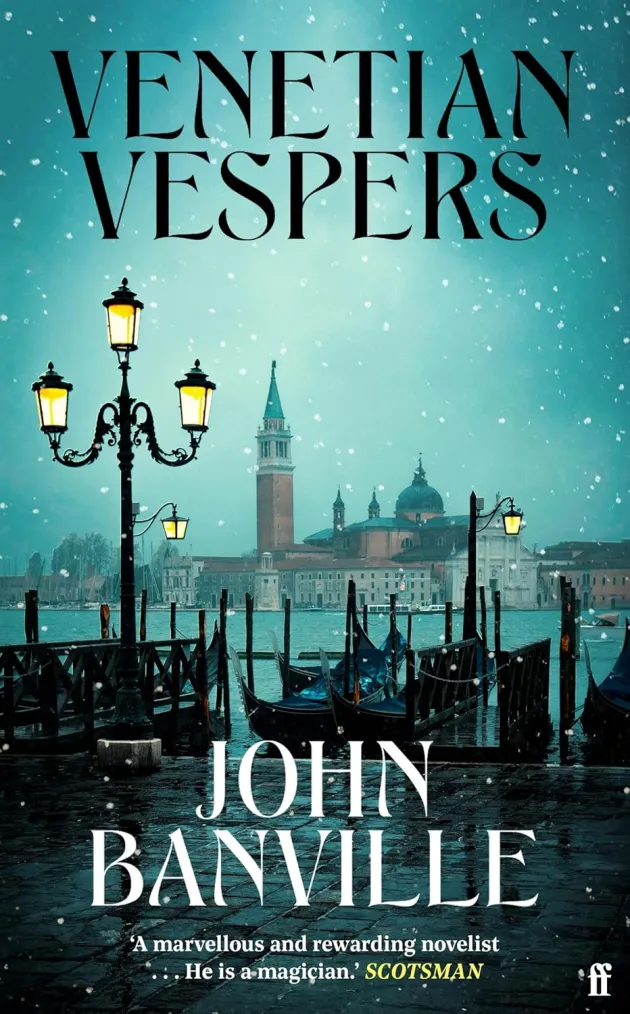
Venetian Vespers (2025)
Venetian Vespers introduces readers to Evelyn Dolman, the latest figure in the Banville’s “Fool’s Gallery”. Dolman is a Grub Street hack whose life takes a fateful turn when he enters a loveless marriage with Laura Rensselaer, daughter of an American oil tycoon.
The couple travel to Venice in the winter of 1899, a setting whose beauty is undercut by a pervasive sense of rot and danger. Dolman encounters the charming and predatory Fitzjohn twins, Francesca and Freddie. Before long, Laura has disappeared. Events spiral out of control, leaving a dead body and Dolman’s ruination.
Venice has long seduced writers drawn to the city’s macabre undertow—Henry James, Daphne du Maurier, Thomas Mann, Patricia Highsmith, Ian McEwan —and Banville leans into the dissolute charms of the sinking city. Its dark alleys and fetid canals seem designed to disorientate and deceive. Dolman rapidly loses his way both physically and morally in this ‘baneful, waterlogged city’.
The inhabitants Dolman meets are grotesque and wheedling. He notes ‘the stifled rage’ behind ‘violent-seeming’ smiles. Few writers are as skilled as Banville in creating ridiculous, vainglorious protagonists and the reader will surely delight as the wretched Dolman (deservedly) suffers at the hands of the truly vicious.
Blackly comic and hugely enjoyable, Venetian Vespers might be Banville’s most purely entertaining novel to date. It is a worthy addition to the great Venetian tales of the past.
Find a copy of Venetian Vespers in the library
Read Next: Daphne du Maurier, Don’t Look Now and Other Stories; Thomas Mann, Death in Venice
Find a copy of Don't Look Now and Other Stories in the library