The Iveagh Markets: Building Stabilisation Works Update
Published on 24th April 2026

The Iveagh Markets
Building Stabilisation Works Update
Issue 1: April 2026
The Iveagh Markets were developed by the brewing magnate Edward Cecil Guinness, Lord Iveagh, as part of a series of major urban regeneration projects financed in The Liberties area in the late nineteenth and early twentieth centuries.
Originally intended to house street traders displaced by the development of the Bull Alley Estate on nearby Patrick Street, the markets were conceived as a Wet Hall for the sale of fish, meat and fresh produce, and a Dry Hall for the sale of second-hand clothes and household items.
Completed in 1906, the market buildings are vast single-storey structures occupying an entire city block, measuring approximately seventy metres by forty metres. The buildings consist of two semi-glazed roof structures of complex geometric design, supported on cast iron columns and perimeter masonry walls.
These elegant structures combine cast iron, wrought iron and mild steel, achieving considerable clear spans and representing metal-framed construction at its finest.
Dublin City Council, with the support of the Department of Housing, Local Government and Heritage through the Urban Regeneration and Development Fund under Project Ireland 2040, is undertaking emergency repair and stabilisation works at the Iveagh Markets. These works will safeguard this historic structure for future generations and support its return to public use.
This newsletter provides a regular update on the ongoing work to stabilise the roof and structure of the Iveagh Markets on Francis Street. Work commenced in January 2026 on the second phase of extensive works designed to secure the building into the future.

Meet the Team
In 2023, Dublin City Council appointed Howley Hayes Cooney Architects to lead the project design team overseeing emergency stabilisation of the roof of the Iveagh Markets.
The wider design team includes:
- Austin Reddy & Co – Quantity Surveyor
- CORA Consultant Engineers – Civil and Structural Engineers
- Black & White Consulting Engineers – Mechanical and Electrical Engineers
- Factfire – Fire Safety Consultant
- Ashview Consultants – PSDP
- IAC Archaeology – Archaeologist

Following earlier enabling works, the second and substantive phase of roof renewal works is being carried out by Kelbuild Ltd. Works began in January 2026 and are expected to take approximately two years to complete.
This project forms part of the capital programme of Dublin City Council and is supported by the Urban Regeneration and Development Fund under Project Ireland 2040.
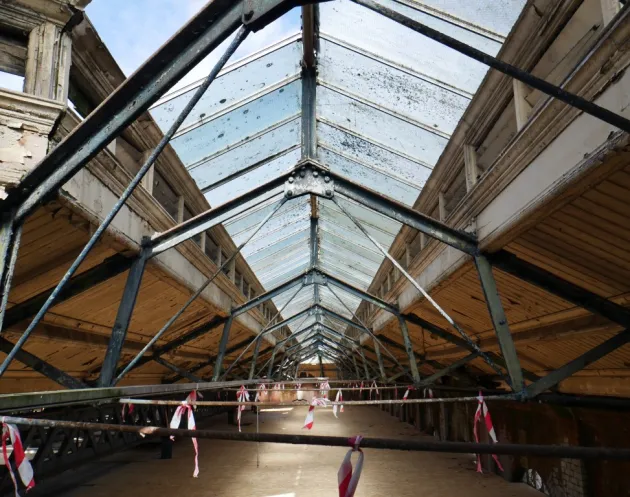
Renewing the Roof
Much of the original roof structure of both the Wet and Dry market buildings remains intact, including large wrought iron and mild steel roof trusses, as well as the timber structure consisting of purlins, rafters and sarking boards.
While historic Westmorland Green slate remains in some areas, roof coverings have been lost in many locations, leaving the building vulnerable to the elements.
A detailed programme of repair has been developed for all iron and steelwork. Larger trusses will remain in place and be fully stripped of lead paint, while smaller trusses may be removed for repair and reinstated.
Roof coverings will be replaced with appropriate materials to provide a fully weather-tight roof. Original slate and cast iron rainwater goods will be repaired and reused where possible. New lead and copper flashings will be installed throughout.
Repairs will also be carried out to brick parapets, and a temporary roof will be installed over the service block between the two market buildings, making the entire complex weather-tight.
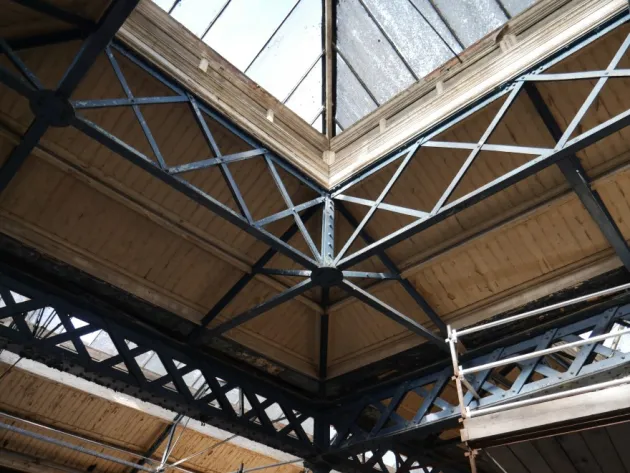
The works include:
- Stabilisation works to the primary structure of the Dry Market building
- Removal of lead-based paint from timber and metalwork surfaces
- Full repair of both market roofs
- Installation of a temporary roof over the service block
Phase 1b works commenced in January 2026 and are expected to take approximately two years to complete.
Q1 and Q2 2026 Works
- Stabilisation works within the Dry Market building
- Erection of scaffold within the Wet Market building
- Removal of lead-based paint within the Wet Market building
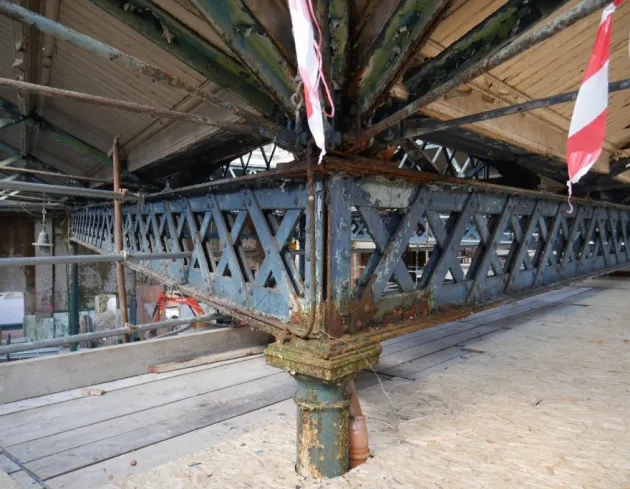
Focus on Glazing
There are currently 581 panes of glass on the roof of the Dry Market and 393 panes on the roof of the Wet Market. These panes date from various periods, with some original rough cast wired glass still in place.
A new glazing system is required to meet modern safety standards for occupied buildings. The replacement system will reflect the original appearance when viewed from below, while all historic glass will be safely stored on site upon completion of the works.