Radon Information for Homeowners, Builders and Employers
Radon is a naturally occurring radioactive gas that can accumulate inside buildings and pose serious health risks. Find information about high radon areas, testing for radon and the role of Building Control.
Radon is created as the uranium in rocks and soils breaks down. Radon is invisible, tasteless and odourless. It can only be detected using specialised equipment. While radon disperses harmlessly outdoors, it can sometimes accumulate to dangerous levels inside buildings and pose serious health risks.
It is the responsibility of employers, homeowners and builders to test for radon.
Health Risks
Radon's radioactive particles can damage lung tissue when inhaled and increase the risk of lung cancer. In Ireland, approximately 350 cases of lung cancer annually are linked to radon exposure.
Radon is easy to test for and it is also easy to reduce the levels of radon in your home or workplace.
Responsibility
Homeowners, developers, employers and building control authorities have different roles and responsibilities related to monitoring and managing radon levels.
Homeowners and Employers
Homeowners and employers are responsible for arranging radon testing in existing buildings. The Environmental Protection Agency (EPA) provides guidance on dealing with an existing radon problem.
Builders and Developers
Builders and developers are responsible for ensuring new buildings reduce the impact of radon. The Technical Guidance Document C (2023 Amendment) outlines best practices for preventing radon in new buildings.
Dublin City Council
Dublin City Council, as a Building Control Authority, is responsible for promoting awareness of radon, managing radon in council buildings and enforcing building regulations to prevent radon in new builds.
Building control authorities make sure that new buildings comply with Building Regulations, including radon measures. If a building does not comply, it won’t receive a valid Certificate of Compliance on completion. Without this, the building cannot be legally occupied or sold.
High Radon Areas
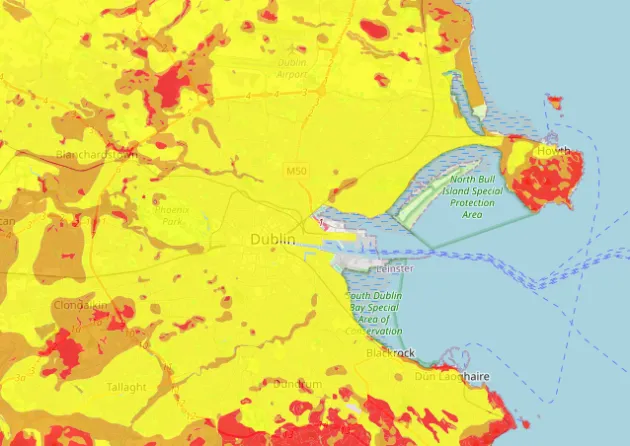
Certain regions in Ireland are designated as High Radon Areas, where homes and workplaces are more likely to have elevated radon levels. You can check if your property is in a high radon area using risk maps managed by the EPA.
Testing for Radon
Digital radon monitors are available to borrow from participating libraries. This is a collaboration between the EPA and Healthy Ireland at your Library. Library members can borrow a digital radon monitor for three weeks, just like a book. The monitor provides a snapshot of radon levels in the home. Monitors are portable, battery-operated and easy to use.
This is not a replacement for the recommended three-month test, but it is a useful first step in identifying potential radon issues. Find more information on how to test for radon in the EPA’s guide.
Legal and Regulatory Requirements
Employers in high radon areas must test their premises. The table below shows acceptable levels of radon in different buildings in Ireland.
| Building Type | Acceptable level or Reference Level |
|---|---|
| Workplaces | 300 Bq/m3 |
| Dwellings | 200 Bq/m³ |
If radon concentrations above this value are found in a workplace, you must take action to reduce the radon levels. This work must be completed within 12 months.
If you get a radon measurement above these levels in your home, it is recommended that you take action.
Find More Information
The EPA provides extensive information and resources on radon, radon testing and what to do if you measure high levels of radon in a building. To access support, contact the EPA directly or visit their dedicated website, Radon.ie, for more information.